Applied Optics 2
Prof. Dr. Robert BRUNNER

Prof. Dr. Robert Brunner
Image: PrivatEmail:Robert.Brunner@eah-jena.de
Phone: +49 3641 205 352
Prof. Dr. Robert Brunner is Professor of Applied Optics at the University of Applied Sciences Jena.
He is spokesperson of the DFG research initiative TOOLS – Tailored Optics for Life Sciences Engineering and the DATIpilot innovation community SpeeD – Spectral Detection for Societally Relevant Applications.
• Wavelength-selective diffraction efficiency in multilayer, multi-order diffractive optical elements
• Compact spectroscopic cross-grating concepts combining broadband response and high spectral resolution
• Axial hyperchromatic spectrometer concepts for compact spectral analysis
• Efficient filter-based spectral sensor systems
• Nano-, micro-, and mesoscale fabrication of optical structures
• Bio-inspired and biomimetic optical systems
Teaching Fields
Teaching activities cover applied optics with a strong focus on practical and system-oriented aspects.
Key areas include micro- and diffractive optics, spectral sensing, and geometrical and physical optics for optical instrumentation.
The laboratories provide a complete infrastructure for optical design, fabrication, and system validation at the nano-, micro-, and mesoscale.
Research in diffractive optics focuses on controlling and tailoring diffraction efficiency in multifunctional diffractive optical elements. Multilayer and hybrid design approaches enable wavelength-selective as well as achromatic performance across multiple diffraction orders [1, 2]. These concepts support advanced imaging and sensing applications, including hybrid diffractive–refractive metrology strategies with independently adjustable axial measurement ranges [3].
In parallel, compact spectrometer concepts are being developed that reduce system complexity while extending functional capabilities. Axial hyperchromatic spectrometers combine refractive and diffractive elements for NIR analysis, enabling wavelength scanning with only small mechanical displacement. In addition, concave cross-grating spectrometers integrate imaging and two-dimensional dispersion into a single optical element. Together, these approaches enable compact and robust spectroscopic systems for scientific and industrial applications [4, 5].
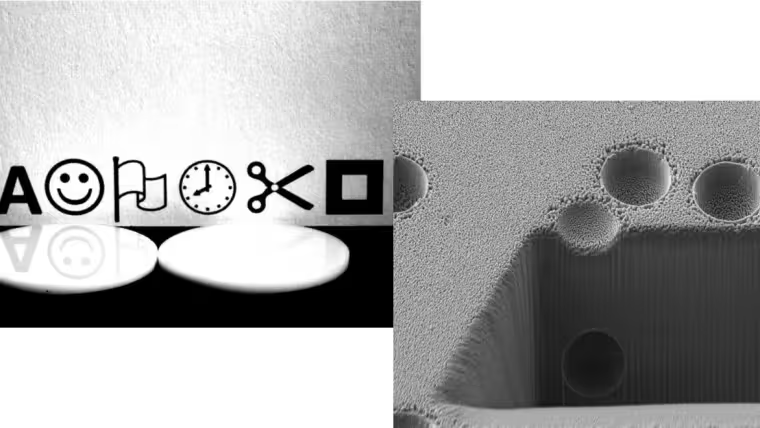
Complementary to these developments, bio-inspired antireflective optical surfaces based on the moth-eye principle are realized in hybrid polymers using reactive ion etching. The resulting nanostructures provide broadband antireflection from the visible to the near-infrared range while maintaining high angular stability, thermal robustness, and enhanced hydrophobicity. These results highlight the potential of durable and multifunctional optical surfaces for demanding environments [6].
[1] Schimdt, L., er al; Journal of the Optical Society of America A, 42(8), 1206-1218 (2025)
[2] Schmidt, L., et al; Optics Express, 33(11), 23850-23864. (2025)
[3] Schmidt, L., et al; Journal of the Optical Society of America A, 43(5), 837-846 (2026)
[4] Werner, L., et al; Optics Express, 33(14), 29337-29350 (2026)
[5] Klimke, S., et al; Optics Express, 33(24), 50482-50495 (2026)
[6] Werner, L. et al; Nanomaterials, 15(7), 490 (2025).