Quantum and Hybrid Light
Dr. Vira BESAGA

Dr. Vira Besaga
Image: PrivateEmail: vira.besaga@uni-jena.de
Phone: +49 3641 tba

Logo Bundesministerium für Forschung, Technologie und Raumfahrt
Image: BMFTRDr. Vira Besaga is currently establishing the HyQu Light junior research group at the Abbe Center of Photonics. The group will officially start in March 2026 and is funded by the BMFTR within the Quantum Futur program.
The HyQu Light research profile focuses on complex states of light that combine non-classical correlations with the distinctive properties of structured and topological light. The research program bridges fundamental studies of such hybrid light states with the exploration of their potential for advanced and noise-resilient measurement concepts. A central goal of the group is to understand how quantum resources carried by hybrid light can enhance performance under realistic measurement conditions, where noise, losses, and sample complexity play a crucial role.
Dr. Besaga has a multidisciplinary background in optical and electrical engineering, with research experience spanning acousto-optics, quantitative phase imaging, spectroscopy, optoelectronics, and quantum optics. She obtained her doctorate from Ruhr University Bochum, Germany, where her work focused on high-precision, non-destructive imaging and metrology using transmission digital holography. In 2021, she joined the Institute of Applied Physics at Friedrich Schiller University Jena, where she developed and pursued experimental research in quantum optics with a focus on quantum polarization-based sensing.
The initial research agenda of HyQu Light is structured around the project “HyQuSens – Quantum and Hybrid Light for Sensing” (BMFTR). Inspired by established approaches in precision measurement and signal extraction, HyQuSens aims to develop sensing concepts based on hybrid light states that can withstand noise. This research direction addresses challenges in precision measurement across various fields, including biophotonics, environmental sensing, and quantum photonic communications. Beyond specific application scenarios, the group aims to develop general principles for robust quantum-enhanced measurements. This will provide a foundation for future research directions and the long-term development of novel sensing technologies.
The research of Dr. Besaga focuses on the generation, manipulation, and application of non-classical states of light and free-space light quasiparticles, as well as their use in sensing and metrology. This includes the following research fields:
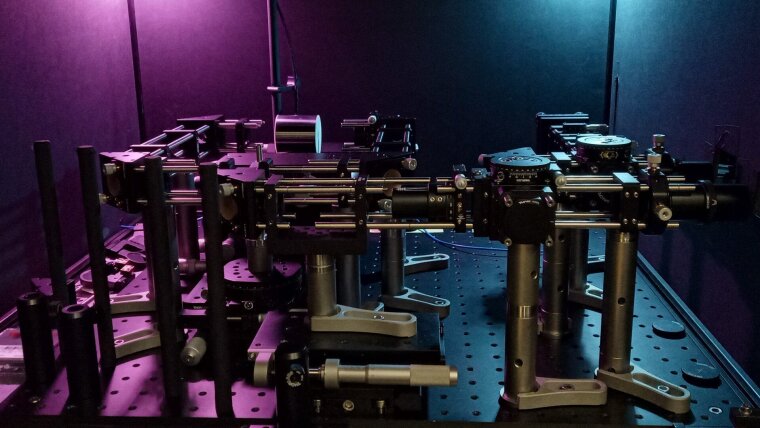
The experimental work of the group builds on modern instrumentation, including:
This experimental platform enables the application and development of advanced photonic characterization techniques, including:
Some of the recent research by Dr. Besaga has focused on quantum-enabled polarization-based sensing. Polarization-resolved light-matter interaction has long been a cornerstone of remote sensing, materials analysis, and biomedical diagnostics. By examining how a sample modifies the polarization state of light, one can access rich structural and functional information such as morphology, chirality, or birefringence with high precision.
Dr. Besaga's work extends these concepts into the quantum regime by exploring polarization-based sensing with non-classical states of light. In this regime, quantum correlations enable enhanced sensitivity, improved signal-to-noise ratios, and increased robustness in complex or highly scattering environments [1]. Recent theoretical and experimental studies have investigated quantum polarimetry with polarization-entangled photons under realistic noise conditions and have demonstrated improved precision compared to classical and heralded single-photon strategies [2-3]. These approaches have been used to examine complex biological samples, such as monolayer cell cultures [4] and human skin-mimicking phantoms [5], and have been complemented by the exploration of advanced, quantum-enabled classification strategies based on tailored polarization states and coincidence-based measurements [6].
[1] L. Zhang et al., Chin. Opt. Lett. 23(9), 092701 (2025).
[2] A. Pedram et al., Adv Quantum Technol., 2400059 (2024).
[3] A. Pedram et al., New J. Phys. 26, 093033 (2024).
[4] L. Zhang et al., J. Biophoton., e202400018 (2024).
[5] V. R. Besaga et al., Laser Photonics Rev., tba, (2026).
[6] V. R. Besaga et al., APL Photonics 9 (4), 041301 (2024).